


This report shows the timeline of the events that lead to the suspension of the UI’3, detailing the students Disciplinary Committee (SDC) proceedings and subsequent court appearances. It’s published ahead of the Federal High Court judgement scheduled for March 31, 2026, to provide context on how the case evolved from a campus protest into a nationally followed legal dispute.
For generations, Nigeria’s public universities were imagined as ladders, institutions through which children of farmers, traders, civil servants, and artisans could climb into the professional middle class. The fees were modest, sometimes symbolic. Admission was competitive, but once inside, students could reasonably expect to finish their education without being priced out of it.
Across Nigeria, the past five years have witnessed an accelerating wave of fee hikes in public universities. Administrators describe them as painful but unavoidable adjustments in an era of inflation, subsidy removal, and shrinking government support.
Few campuses illustrate this tension more vividly than the University of Ibadan (UI), Nigeria’s oldest university. Here, a sweeping fee increase in 2024 collided with a growing student movement against rising costs.
What followed, protests, disciplinary sanctions, and a federal court case now widely known as the UI 3, has turned the campus into a symbol of a national struggle over the meaning of equal access to education.
A Campus at Boiling Point
In August 2024, the governing council of the University of Ibadan approved a significant upward review of fees for the 2023/2025 academic session. But the increase did not begin in August, the first signs had emerged months earlier.
In February 2024, the university management introduced an upward review of fees for fresh students as part of the 2023/2024 academic session. Internal memoranda showed that charges rose sharply, with some departments moving from about ₦64,600–₦69,600 to between ₦203,000 and ₦412,000, an approximate increment of between 450 and over 750 percent.

The new structure included bundled charges such as technology and utility levies, alongside additional laboratory and professional fees for faculties like Medicine and Pharmaceuticals, Sciences. By April 2024, the Dean of Student Affairs confirmed the revised figures, which had already been reflected on the university’s payment portal.
By August, the situation escalated. A follow-up memo dated August 30, 2024, and signed by the Registrar, G.O. Saliu, reiterated the approved fees, set deadlines for payment, and directed students to vacate campus amid growing protests.

For years, many students had paid between ₦24,000 and ₦50,000 depending on the program and level. The revised structure introduced charges reportedly ranging from roughly ₦230,000 to ₦312,000. In some cases, the increases amounted to nearly tenfold jumps within a remarkably short period.
Students struggling with rising living costs suddenly faced fees that rivalled those of some private universities. Many families, already stretched by inflation and currency depreciation, found themselves unable to pay.

Nigeria had entered one of its most turbulent economic periods in decades following the federal government’s removal of fuel subsidies in May 2023. Transportation costs surged. Food prices climbed sharply. Inflation climbed above 30 percent. For students already living on thin margins, the new fees felt like the final blow.
Although the decision was met with widespread criticism from the student and concerned members of the public, the university management defended the decision as unavoidable. Federal allocations, they argued, had stagnated while operational costs, electricity, diesel, laboratory equipment, internet infrastructure, and staff welfare continued to rise.
They pointed to a longstanding debate in Nigeria’s education sector: the chronic underfunding of public universities. For decades, education advocates have argued that Nigeria spends far below the benchmark recommended by the United Nations Educational, Scientific and Cultural Organization (UNESCO), which suggests that about 26 percent of national budgets should go to education. Nigeria’s allocations have consistently fallen well below that threshold.
However, the gap between policy and reality has tangible consequences for students. As fees climbed, families that once relied on public institutions as a pathway to professional and academic advancement found themselves struggling to keep pace. The sudden surge, in some cases approaching tenfold within a single year, transformed what had been a manageable contribution into a barrier that threatened to exclude large numbers of undergraduates.
READ ALSO: “I May Have to Say Goodbye to Education”—UI Students Lament 450–750% Fee Hike
Under the Oluwatobiloba Samson-led administration, the Students’ Union strongly condemned the increment. In an official statement, the union declared that

“The union condemns this increment in strong terms and requests that this proposed increment be reverted to the status quo.”
The union leadership at the time agreed that the hike would disproportionately affect low- and middle-income families, making access to education at the nation’s oldest university increasingly difficult, and requested a meeting with the university management at the time.
However, there was no clear resolution from the engagement. The fee structure remained unchanged, and students saw no immediate relief or concrete policy shift from the discussions. As tensions persisted, frustration grew across campus. What began as formal dialogue gradually gave way to more visible forms of resistance.
By May 2024, the situation had escalated, a small group of students staged a symbolic protest during the inauguration of new student union executives that brought in the Aweda-led administration, holding placards to register their opposition to the fee hike, with the inscription “#FEESMUSTFALL,” an action that would later come to define the now widely referenced UI3 case.
Timeline of the Prolonged Disciplinary Process
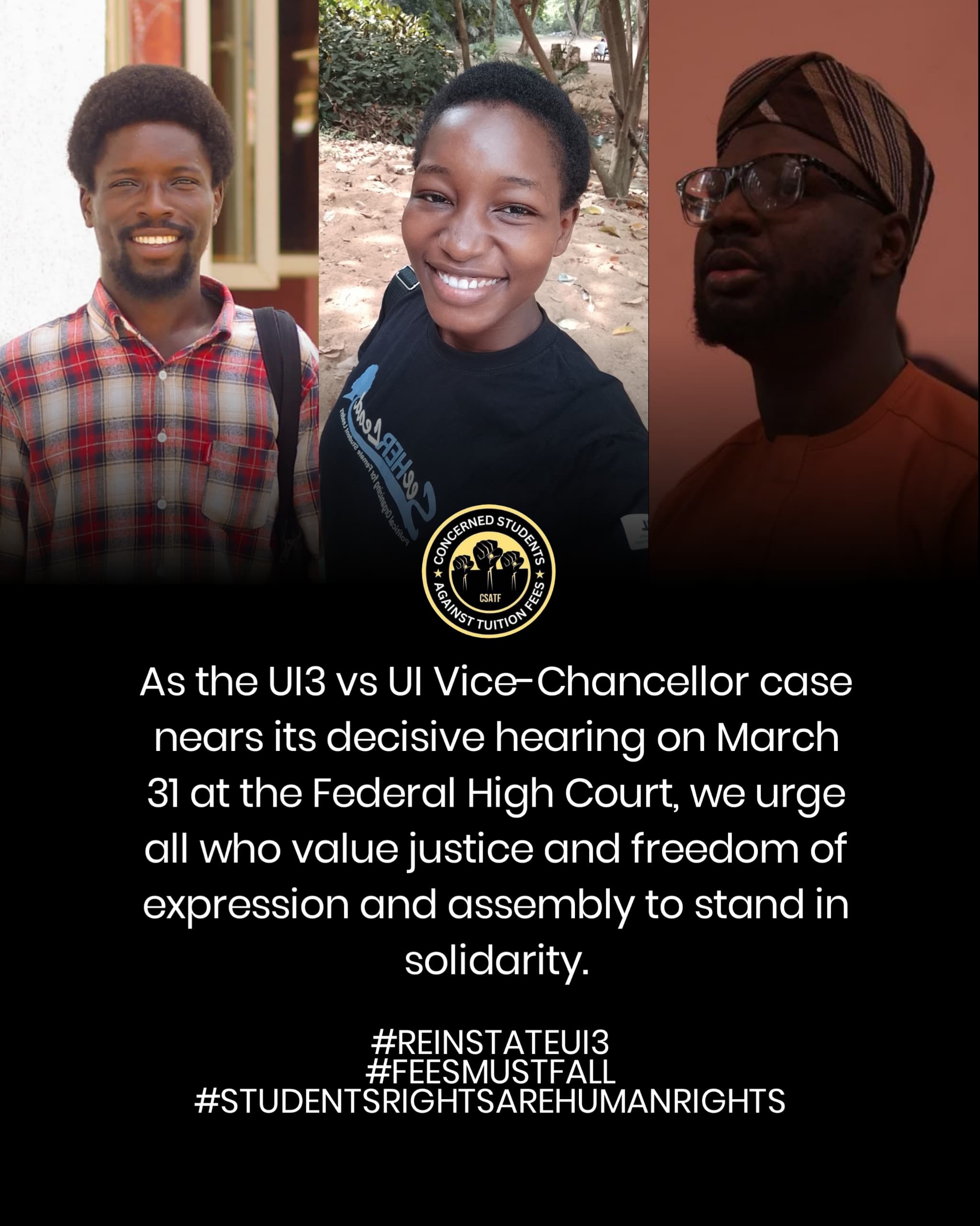
On May 24, 2024, eleven days after the inauguration protest, the Students’ Affairs Division issued separate letters to the three students, Ayodele Aduwo, a fourth-year History student; Mide Gbadegesin, a postgraduate student at the Institute of African Studies; and Nice Linus from the Faculty of Law, accusing them of gross misconduct linked to to the protest. The letter was to formally notify them that their actions were under review by the university.

The students replied to the allegations on May 28, 2024. In their response, they requested details of the accusations and asked the university to specify the acts that constituted misconduct, as well as the rules they were alleged to have violated.
Following this, the students were invited to appear before the Students’ Disciplinary Committee. They were invited to appear before the Students’ Disciplinary Committee (SDC) for the first time in June 2024.
The case remained open and later extended into 2025, with the students required to appear again before the committee as part of the continued disciplinary process.
On June 30, 2025, the students appeared before the SDC again. The students (at least Aduwo and Gbadegesin) were summoned to a Fact-finding committee of the SDC via a letter dated June 25, 2025.

On July 14, 2025, the Central Students’ Disciplinary Committee delivered its final decision, finding the students guilty of gross misconduct and directing that Aduwo Ayodele and Mide Gbadegesin be rusticated for four semesters, effective from the second semester of the 2024/2025 academic session.
A subsequent SDC letter was addressed to Nice Linus, dated August 29, 2025, shows that official correspondence continued after the committee’s decision. This suggests that post-verdict procedures and documentation followed the conclusion of the hearings.
From the issuance of the initial query in May 2024 to the last known correspondence in August 2025, the disciplinary process spanned over a year.
The Trailer: UI’3 at the Federal High Court
The three students challenged the sanctions in court.
Their lawsuit, filed at the Federal High Court in Ibadan, argues that the suspensions violate constitutional protections of freedom of expression and peaceful protest.
The case has since become widely known as the UI 3 case, drawing attention from civil society organizations and student movements nationwide.
A judgment is expected on March 31, 2026.
A National Symbol Emerges
What might once have been an internal disciplinary matter quickly escalated into a national conversation.
Human rights groups condemned the suspensions. Among them, Amnesty International described the action as a form of “victimisation” of students for peaceful dissent and called for their immediate reinstatement. Other civil society coalitions echoed similar concerns, warning that suppressing student protest could undermine democratic culture within universities.
For many students across Nigeria, the UI 3 case has come to represent a broader question: whether public universities can punish students for speaking out against policies that directly affect their education.
The story also elevated one of the students, Ayodele Aduwo, into an unexpected symbol of resistance. Videos circulating on social media showed him urging fellow students not to be intimidated.
The dispute, once confined to a single campus ceremony, had now become part of a national debate about academic freedom and the rights of students.
The Wave Beyond Ibadan
The University of Ibadan is not alone in confronting this conflict.
Across Nigeria, public universities have implemented major fee increases over the past few years. The pattern has been strikingly similar: universities citing rising costs and reduced government funding, followed by protests from students who fear exclusion from higher education.
At the University of Lagos, proposed fee increases in 2023 triggered widespread outrage after some charges rose by several hundred percent. The backlash forced university authorities to partially reverse the decision.
Other institutions, including Ahmadu Bello University and the University of Nigeria Nsukka, have faced similar disputes as administrators introduced higher charges.
In March 2026, nursing students at the Nnamdi Azikiwe University Teaching Hospital in Nnewi staged protests after their fees reportedly jumped from ₦90,000 to ₦580,000 — an increase of more than 500 percent.
Such numbers are reshaping the landscape of public education.
Student organisations warn that thousands of undergraduates now face the possibility of dropping out each year. Families that once saw university as attainable are reconsidering whether they can afford the cost.
Waiting for March 31
The upcoming ruling in the UI 3 case is unlikely to settle the broader debate. Yet its symbolic weight is considerable.
A judgment overturning the suspensions could strengthen student movements and reinforce the principle that peaceful protest is part of campus life. A ruling that upholds the disciplinary actions could signal that universities possess wide authority to restrict dissent within their walls.
Either way, the underlying financial pressures facing Nigerian universities will remain.
For now, the three students at the centre of the lawsuit have become unlikely protagonists in a national struggle. Their placards — simple pieces of cardboard calling for fees to fall — have forced a country to confront uncomfortable questions about who gets to study, who gets left behind, and what the future of public education will look like.
The outcome of that struggle may determine whether Nigeria’s universities remain ladders of opportunity or become gates that only a few can pass through.
This article was first published by the Zik Press organisation
You must be logged in to post a comment.