


By Gbayesola Samuel
Waste management challenges have continued to resurface across the University of Ibadan despite temporary interventions by the university authorities.
Over the past few months, IndyPress has documented recurring cases of delayed refuse collection, indiscriminate dumping and overflowing waste points in student residential areas.
While temporary clean-up exercises have followed some of these reports, subsequent visits by our reporters found that the underlying problems persist.
Previous Reports, Same Problem
Earlier in the first semester, IndyPress reported how refuse accumulated for days around locations including Awo Hall, Indy Hall and Tech Road before being evacuated.

In another report published during the peak of the rainy season, the article highlighted how poorly managed waste contributed to blocked drainage channels, raising concerns about flooding and environmental sanitation.

Although authorities later cleared the affected site, the intervention proved temporary rather than lasting.
To understand why the problem continues to recur, IndyPress undertook this investigation across student hostels, staff residential areas and other key locations on campus.
Our reporting found recurring delays in refuse evacuation, inadequate waste collection facilities, the use of inappropriate dumping points and stark differences in waste collection practices across different parts of the university.
Through eight days of field observations, interviews with students, staff, hall management and the university’s waste contractor, IndyPress examined why the problem persists and what it means for those who live and work on the campus.
What IndyPress Observed
To assess the extent of waste management challenges on the University of Ibadan campus, IndyPress conducted field observations between July 11 and July 18, 2026, covering student residential areas, academic precincts and staff communities. Through repeated visits to strategic locations, IndyPress documented the condition of refuse collection points, waste bins and dumpsites to determine whether the problem was isolated or recurring.


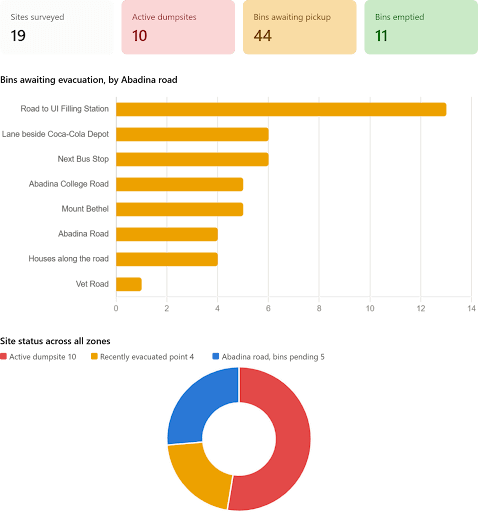
Across the locations visited, IndyPress documented 69 waste features, comprising 11 emptied waste bins, 44 waste bins awaiting evacuation, 10 active dumpsites and four recently cleared dumpsites. The observations suggest that although refuse evacuation takes place in some parts of the campus, delays in waste collection remain a recurring challenge across several locations.
One of the most prominent examples is along the road leading to Obafemi Awolowo Hall, where refuse from the hall is deposited. During multiple visits, heaps of waste remained at the collection point, with visible signs that refuse had accumulated over an extended period.

Similar conditions were observed at Independence Hall and Nnamdi Azikiwe Hall, where designated refuse collection points contained exposed waste left in the open.

At Nnamdi Azikiwe Hall, the dumpsite beside the laundry area contained accumulated refuse exposed to the elements.

The waste management challenges extended beyond the halls of residence. Active dumpsites were also observed beside the Department of Mathematics, near the Department of Anthropology, opposite the Botanical Garden, and opposite the Aquaculture Department, adjacent to Access Bank, amongst others.


In several of these locations, decomposing refuse emitted foul odours and remained in open spaces frequently used by students, staff and visitors.
A contrasting pattern emerged in staff residential communities. Within staff quarters located in the university’s core campus, waste bins were generally observed to be emptied and properly maintained.
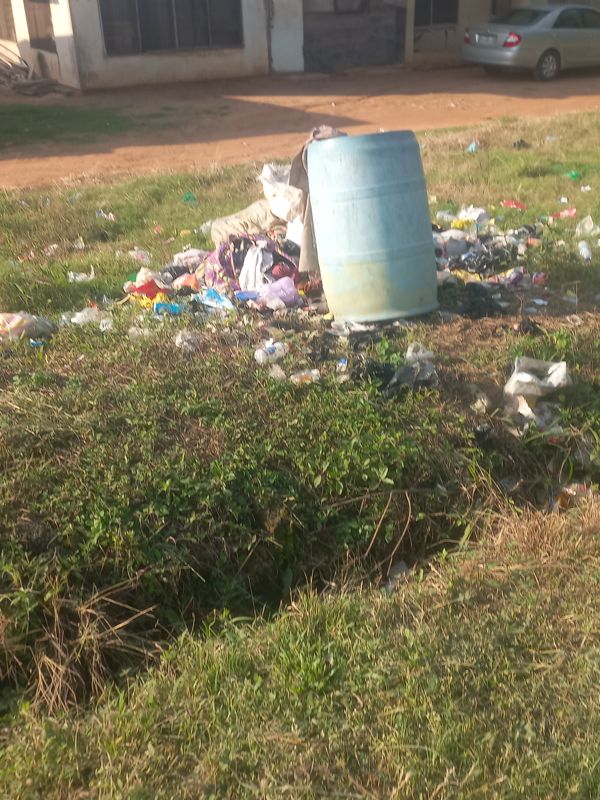
However, conditions differed markedly in Abadina, where many non-teaching staff reside. Across the community, IndyPress documented 44 waste bins awaiting evacuation, compared with 11 bins that had recently been emptied, alongside three active dumpsites. In some locations, evidence of burnt refuse suggested that residents had resorted to open waste burning, a practice often associated with prolonged delays in waste evacuation.
Beyond the physical presence of accumulated waste, residents described the effects of living with refuse that often remained uncollected for weeks.
For Residents, the Problem Is More Than an Eyesore
Beyond the overflowing bins and open dumpsites, the recurring delays in waste evacuation have become a daily reality for both students and staff living on the University of Ibadan campus. Residents who spoke with IndyPress described living with persistent foul odours, growing sanitation concerns and uncertainty over when accumulated refuse would eventually be cleared.

Speaking with IndyPress, a student resident who preferred to remain anonymous said the dumpsite near Obafemi Awolowo Hall has significantly affected residents’ daily experience.
“When they started dumping here, it was kind of weird. When it all started, we were like, imagine you coming from class, and this is what you’re seeing first. The fact that when it rains, or when it’s filled up, the smell is already coming out.”
She explained that the refuse collection point was previously located around the Awo Hall/Mount Zion area before it was moved to its current location. According to her, burning the refuse is not a practical solution because of the volume of waste, while the location itself leaves residents with few alternatives.
“Another issue is that if they always come to get it almost immediately it is filled, it would be better, but they don’t. And there’s no means of maybe burning it or something. They can’t even burn here. Can’t do that. That’s another pollution on its own.”
For many residents, the issue is not simply that waste is generated, but that it remains at collection points long after the bins have reached capacity.
While IndyPress has previously reported students’ concerns about waste management across the campus, similar frustrations were expressed by non-teaching staff residing in the Abadina community.
Speaking with IndyPress, Mr. Ben Oluwatoba and his friend, Mr. Stephen, both residents of Abadina, described what they said had become a prolonged struggle with waste disposal in the community.
According to Mr.Oluwatoba, refuse contractors have visited the area only once this year, forcing many residents to resort to burning their waste.
“They can maybe once this year now. We do the burning by ourselves.”

He further claimed that although waste disposal fees are deducted from residents’ salaries, contractors have reportedly told them they have not received payment.
“They will tell you that the university management has not paid them. And that money has been deducted from our salary.”
Describing the situation, he added:
“For three months now, four months now, we have been doing this for ourselves. If you pour the dirt there and they don’t go and pack it, to this side, you set fire and go. Why is there a delay?”
Mr. Stephen shared similar concerns, saying residents continue to pay waste disposal charges despite experiencing prolonged delays in refuse collection.
“Every month, we are paying. This rubbish money has always been deducted every month. But seeing them come and pack the rubbish away now, they won’t come. And I don’t blame them, I blame the university management. When they tell you they have not paid them, we have still paid.”
He also alleged that refuse collection in the area is handled by UI Ventures and suggested that delayed payments may be responsible for the contractors’ absence.
“It is being contracted out to UI Ventures, who are the ones supposed to come and pack the rubbish. But no one knows. I believe maybe they have not paid them; that’s why they have not been coming too. And it is still really affecting us.”
Recalling a personal experience, Mr. Stephen said he once paid refuse collectors directly to evacuate waste from his residence.
“I could remember there was a time they came around my house at Idea Consult. They carried the dustbin there. I had to tip them. I gave them ₦1,000. I packed every rubbish in my compound and gave it to them to take away. It is not supposed to be like that. And now there is rain.”
He said the rainy season has only worsened the situation.
“During the rainy season, as soon as a breeze blows, everything is scattered. Every morning, you start packing it one by one, gathering it there, and then you put out the fire.”
According to him, the consequences are borne almost entirely by residents.
“We are the ones facing the hazard. They don’t stay in the school. They come to work and then go. But we are the residents. We live here. We know how we perceive the odour.”
He also expressed concern that some members of staff living outside the university dispose of their household waste in bins within the community.
“Most UI staff who live outside pack their waste inside their boots, and when they get to UI, they throw it inside the dustbin here. They are not supposed to do that. We, the residents, are the ones that will face the smell. I am burning it.”
Another resident, Mr. Okechukwu Nwachukwu, a non-academic staff who reside around *Oke Bethel lane, also questioned the state of waste management in the community, saying residents continue to pay monthly waste disposal charges despite the condition of the refuse collection points.

“They deduct money monthly from our salaries. There’s some amount of money they deduct from each household.”

He described the refuse collection point along the Abadina College Road as an embarrassment to both the university and the surrounding community.

“That dustbin along the Abadina College Road is an eyesore to the school. It is also a disgrace to the community. They don’t pack the refuse there every week. This is the road students pass through, staff pass through. It shouldn’t be like this.”

While residents attributed the problem to prolonged delays in collection, IndyPress sought the response of those directly responsible for evacuating waste across the university.
What the Contractor Says
Responding to concerns raised by students and staff, the waste management contractor engaged under UI Ventures attributed the delays in refuse evacuation across some parts of the campus to operational challenges, particularly the breakdown of their collection vehicles.
Speaking with IndyPress, the waste contractor Mr Okeniyi confirmed that his team is responsible for evacuating refuse from student halls of residence and staff residential areas, including the Abadina community, under an agreement with the university.
“We are the contractor. We have an agreement with the University of Ibadan. They normally pay us a certain amount every month. We evacuate all the refuse and dispose of it.”
Addressing complaints about delayed refuse collection, he explained that the problem arose after one of the company’s vehicles developed mechanical faults.
According to him, the contractor operates three compactors and one tipper. However, he said one of the compactors, particularly the smaller vehicle used to access locations where larger trucks cannot enter, broke down, affecting collection in several areas.
“There are some areas like Mellanby and Kuti where our big truck cannot enter the dumpsite. We normally use the small vehicle to evacuate the refuse from those places. So if the small vehicle develops a fault, that’s where the issue comes in.”
He said this had resulted in prolonged delays in some locations.
“Some areas will say it has been over a month since we packed their refuse. That is the issue. If all our vehicles are working perfectly, there is no issue.”
The contractor also responded to reports that some residents had resorted to burning refuse because of the delays. While acknowledging that such complaints had reached the company, he maintained that the underlying cause remained the mechanical failure of collection vehicles.
“That is the only issue we have. If all the vehicles are working perfectly, we don’t have any issues.”
He further disclosed that, at one point during the reporting period, all four operational vehicles were out of service due to different mechanical problems. However, he said repairs were ongoing and that collection had already resumed in some parts of the campus.
“Now, two are working perfectly. One has already left this morning, and the other one has just left.”
On concerns over what appeared to be illegal or inappropriate dumping sites, the contractor said his company does not determine where refuse is deposited.
Instead, he explained, each hall of residence or unit decides its designated collection point, while the contractor’s responsibility is limited to evacuating waste from those locations.
“Anywhere they dump their refuse, we just go there and pack it. That is our own work. If the hall management decides to change the location tomorrow, they can change it.”
He also claimed that some refuse found at collection points may not originate from the university community alone.
“Some people carry refuse from outside and drop it at the dumping sites.”
Although this allegation have not been independently verified various response gotten by IndyPress indicate a possible occurrence of such with areas like the collection site beside Anthropology department.
It is worth noting tha during the period of these inquiries, IndyPress observed refuse being evacuated from some locations, including parts of Mellanby, Jaja Avenue and the dumpsite along tech road, corroborating the contractor’s claim that collection had resumed following repairs to some of the company’s vehicles.
However, overflowing bins and active dumpsites remained in several other areas visited, particularly within the Abadina community and parts of the student residential areas, indicating that the operational challenges had not been completely resolved.
While he also attributed the delays largely to operational setbacks, questions remained about the location and management of some refuse collection points, particularly around student residences. IndyPress spoke with the Health Minister of Obafemi Awolowo Hall to understand what led to the current state of Awo Hall waste collection.
Why the Awo Dumpsite Was Moved
Awo Hall Health Minister, George Susan explained that the refuse collection point was relocated from its former position during the last academic session after concerns that the previous site was obstructing drainage channels and contributing to flooding whenever waste accumulated.
According to the Health Minister, because refuse evacuation was often delayed, waste would remain at the former location for extended periods, eventually blocking the flow of water.
“When I made inquiries, I was told the former place they were using was blocking the drainage and it was leading to a lot of problems. The UI Ventures people that come to pack the refuse don’t come often, so because it was behind the hall, the waste just piled up and blocked the flow of water.”
However, the relocation has created a different challenge.
The Health Minister described the present collection point, located near the entrance to the hall, as unsightly and said it detracts from the appearance of the residence.
“Left to me, I would even say that it’s defacing Awo. I don’t like it.”
She said hall management has explored possible interventions, including constructing a more structured enclosure around the dumpsite to contain the waste, but those efforts have been limited by administrative procedures.
“I even suggested that they could build something with bricks so the cleaners could dump the refuse into it and lock it up, so it doesn’t mess the whole area. But even if you have money to do something, you cannot do it until you get permission from the right authorities.”
According to her, the Hall Warden had already escalated the matter to higher university authorities but had yet to receive approval for any structural intervention.
“The last conversation I had with the Hall Warden was that she had reached the highest authority she could, and the person was not ready to take any step.”
In the meantime, she said the hall’s immediate response has been to repeatedly contact the waste contractor whenever the collection point becomes full. However, she noted that obtaining a response has not always been straightforward.
“Even when you call them, it’s not every time they respond. The number I had, I was later given another number, and nobody responded. So I now communicate through the supervisor of our cleaners because she has a contact she reaches out to. She’s really the one ensuring that they eventually come and pack it.”
Even then, she said, the evacuation is often only partial.
“I don’t think they’ve ever cleared the place completely. They just pack part of it so there will be space to continue using it. At times, it’s just so messy.”
The Bigger Picture
While the reason behind the current location of the Awo Hall refuse collection site has been identified, the waste management crisis in the University of Ibadan ultimately exposes a deeper multiple interconnected problems; from the delays in refuse evacuation, inadequate waste infrastructure, unsuitable collection points and operational setbacks which has resulted in the accumulation of waste across parts of the campus.
Although refuse evacuation resumed in some locations during the reporting period, observations over a few weeks indicate that the university’s interventions remain largely reactive. Without sustained improvements to collection schedules, infrastructure and oversight, the cycle of accumulation and emergency evacuation is likely to continue. Most importantly impacting the health and the overall wellbeing of the thousands of students and staff who live, work and study on the campus.


You must be logged in to post a comment.